






What is BARF for cats?
Everything you need to know about raw feeding cats
Table of contents

What does "BARF" mean for cats?
The term "BARF" was originally coined in connection with raw feeding dogs. In English, it stands for “Bones And Raw Food” or “Biologically Appropriate Raw Food.”
In Germany, the designation “Biologically Species-Appropriate Raw Food” became established, introduced in the 1990s by Swanie Simon. Already back then, the first specialist literature on homemade food for cats appeared. However, the method only gained real momentum through scientific studies in the following decades, which laid the foundation for the form of raw feeding for cats practiced today.
Meanwhile, BARF has also become very popular among cat owners. More and more people are choosing this natural and species-appropriate diet to keep their cats healthy and close to nature.
The prey model – the basis of BARF
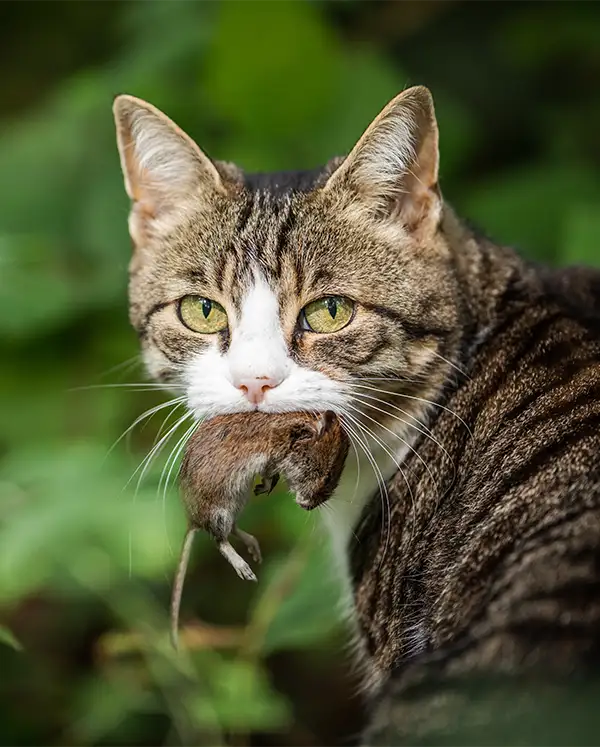
The idea behind BARF is actually quite simple: cats should be fed in a way that corresponds to their natural needs. In the wild, they would hunt and eat small prey such as mice or birds and thereby take in everything their body requires – muscle meat, organs, bones and even a bit of plant material from their prey’s stomach.
This is exactly the principle that BARF replicates. With fresh, raw, unprocessed ingredients, the composition of a prey animal can be reproduced as closely as possible. This way, cats receive a balanced diet that is aligned with their actual needs. It’s an ideal form of nutrition for both healthy cats and those with special requirements – for example, allergies or illnesses.
With BARF, you as the owner always know exactly what ends up in your cat’s bowl. Every meal can be individually put together and tailored precisely to your cat. This makes BARF not only transparent and flexible, but also a healthy, natural alternative to conventional dry or wet food.


From wildcat to house cat – why BARF is so natural and species-appropriate
To understand why raw feeding is considered the most natural form of nutrition for cats, it helps to take a look into the past. Our domestic cats most likely descend from the African wildcat living in North Africa. Even though domestication goes back several thousand years, cats have retained many physical traits showing their close relation to wildcats. Above all, one thing has never changed: cats are and remain strict carnivores.
Outdoor cats – just like their ancestors – would mainly feed on small rodents, insects, and birds. Their digestive system is adapted to these prey animals, from which they obtain everything they need: proteins, fats, vitamins, minerals, and even fiber – all in their most natural form, raw and unprocessed.
This is exactly where raw feeding comes in. When putting together BARF meals, we follow nature’s model: the majority of meals therefore consist of animal components. Plant components play only a minor role in BARF. In essence, BARF simply replicates what cats have always eaten – in contrast to many industrially produced foods, which often contain large amounts of grains or plant fillers.
From both a biological and historical perspective, raw feeding is the most species-appropriate form of nutrition for cats. It meets their natural needs, is easy to digest, and enables optimal absorption of the nutrients it contains.
Key ingredients of a BARF meal
To provide cats with truly balanced nutrition that meets their needs, various food components are required, tailored to the cat’s physiological characteristics. Cats are strict carnivores, so the main components of BARF rations should be of animal origin.
A high-quality, balanced BARF meal for cats consists primarily of muscle meat, complemented by smaller amounts of animal fat and organs. Bones or a bone substitute are also essential.
To mimic the indigestible parts of prey animals such as fur or feathers, a small plant-based portion is added – usually around 5%, in the form of finely pureed or grated vegetables. For a truly complete ration, certain supplements are indispensable. These include especially taurine, which cats cannot sufficiently synthesize on their own, as well as, for example, seaweed meal to provide iodine.
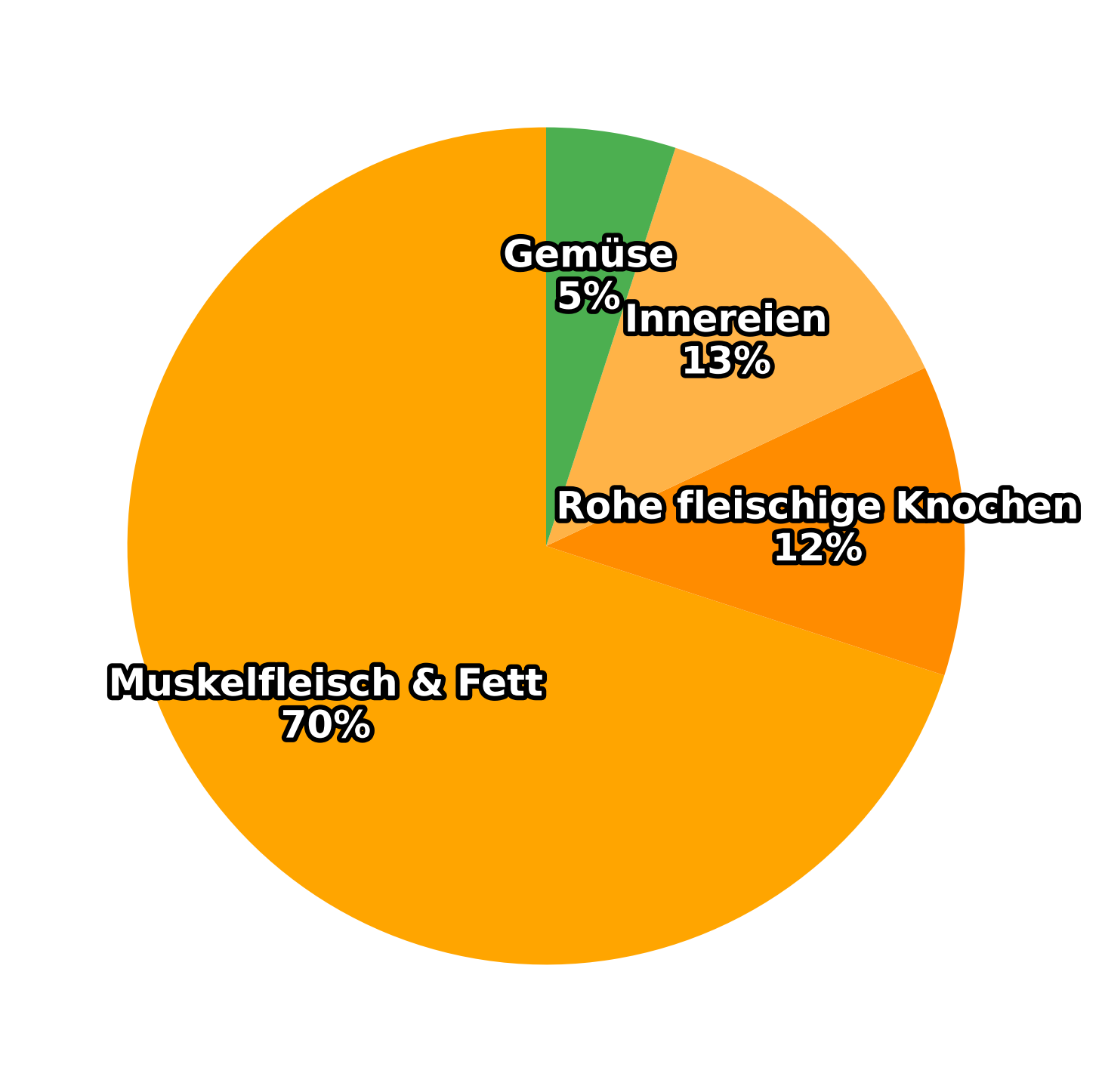
The exact composition of a BARF meal for cats, however, depends greatly on the individual: age, weight, activity level, possible allergies or illnesses, and not least the acceptance of different foods all play a decisive role. For this reason, there are no uniform standard recipes. This makes BARF demanding on the one hand, but at the same time gives cat owners the opportunity to tailor their cat’s diet in a very targeted and individual way.
The components of a BARF meal for cats
A balanced BARF diet thrives on variety in the menu. In principle, the following animal and plant components are suitable for putting together BARF meals for cats:
Muscle meat
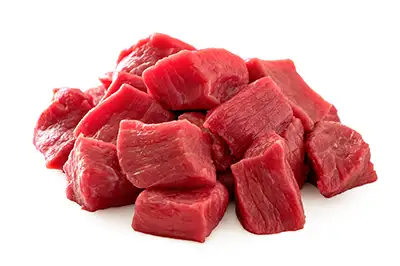
Muscle meat forms the basis of every BARF meal. It provides high-quality proteins, essential amino acids, and important fat. Poultry such as chicken, turkey, duck, goose, or ostrich are particularly popular. But also beef, lamb, rabbit, horse, or fish can be fed – provided the cat accepts them.
Organs
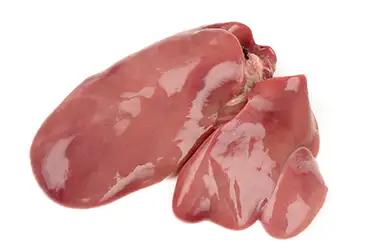
Organs are real nutrient powerhouses and supply your cat with important vitamins and trace elements. The most important organs for cats include heart and stomach, but also lung and spleen can be fed, provided the cat accepts them. Liver is an important source of vitamin A for cats and should – if accepted and tolerated – be included in every recipe. But caution: don’t overdo it, as vitamin A can be overdosed.

Raw meaty bones (RMB)
Raw meaty bones are the main source of calcium in BARF meals. Suitable options include poultry necks, wings, thighs, or carcasses. In general, it is advisable to purchase or feed bones that are very finely ground. If the cat still does not accept bones in this form, you can alternatively rely on (meat) bone meal or other supplements as sources of calcium and phosphate.

Vegetables
In grated or pureed form, vegetables serve as a source of fiber and support your cat’s healthy digestion. Carrots and pumpkin are particularly suitable.

Supplements
Supplements may be required to varying extents depending on life stage, health status, and the composition of BARF meals. However, some additions such as taurine, vitamin D, vitamin E, iodine, and omega-3 fatty acids must be included in almost every BARF meal. These nutrients can be supplied through both natural and synthetic supplements.
Putting together BARF meals correctly
To prepare nutritionally balanced BARF meals for cats, certain points should be considered. A cat’s nutritional needs are closely linked to its natural prey, and meals should therefore be structured accordingly. To avoid over- or undersupply of nutrients, individual recipes should always be created. You will soon find more information as well as a sample recipe in our blog post “How to BARF my cat.”

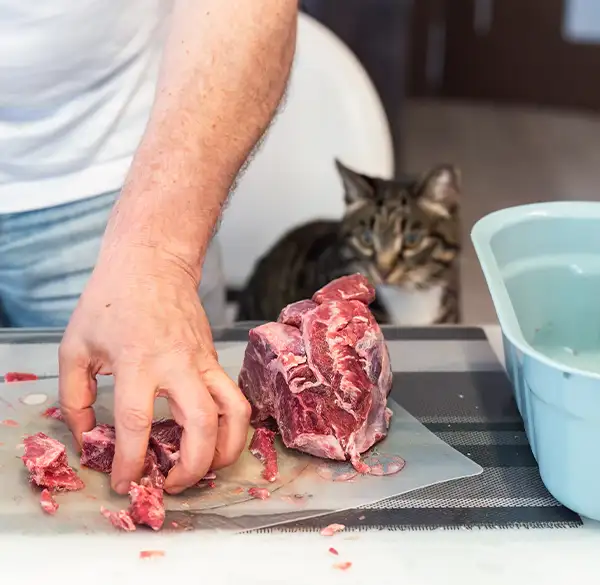
Which utensils do I need for BARF feeding?
To make BARF feeding your cat easier, you only need a few basic kitchen utensils. Sharp knives, cutting boards, bowls, as well as kitchen and precision scales are particularly useful. For processing larger quantities, an electric meat grinder is worthwhile, and a hand blender or mixer is helpful for chopping vegetables.
For hygienic handling, it is advisable to use separate utensils for BARF and to store prepared portions in freezer containers or bags. This keeps preparation simple, clean, and safe – almost like cooking for yourself.
BARF feeding for cats: benefits and tips for getting started
BARF allows cat owners to consciously and individually shape their pet’s diet. Many report positive changes after switching to fresh, raw food, such as shinier coats, improved digestion, or increased well-being. The natural, unprocessed ingredients provide essential nutrients that are easily utilized in this form and can holistically support your cat’s health.
A major advantage of BARF is the full control over the food composition. You always know exactly what goes into the bowl – without unnecessary additives or inferior by-products. This feeding method can be especially helpful for cats with allergies or intolerances.
Since cats are strict carnivores, the focus in BARF feeding is on high-quality animal proteins. Important nutrients such as taurine, which is essential for cats, as well as certain vitamins and minerals, must be supplemented in sufficient amounts. A balanced recipe is therefore crucial to avoid deficiencies.
Especially in the beginning, BARF can seem a bit complex. The transition requires learning and patience – both from you and your cat, who often has to get used to the new food slowly. With a well-thought-out feeding plan and a bit of experience, however, a routine quickly develops, and preparing meals becomes easier.
As with any feeding method, there are important points to consider with BARF: the correct composition, hygienic handling of ingredients, and a slow, stress-free transition are essential. Those who are well-informed, seek professional advice if necessary, and proceed step by step and with patience during the transition can certainly overcome these challenges successfully.
Not every cat accepts BARF immediately – and sometimes raw feeding is simply not feasible in everyday life. In such cases, a high-quality wet food can be a good alternative to provide your cat with a balanced and species-appropriate diet. Most important is that the chosen feeding method suits both the cat and your lifestyle, and can be implemented sustainably in the long term.
BARF feeding recommendation for cats
As a guideline, you can assume a daily food amount of about 25–30 g of food per kilogram of body weight for your cat. However, this is really just a rough reference value. The actual requirement can vary greatly depending on age, activity level, health condition, and other factors.

The right BARF food amount in every life stage
A cat’s nutrient and energy requirements change over the course of its life. Kittens need significantly more energy and high-quality nutrients in order to grow healthily and develop optimally. They should therefore be allowed to eat as much as they want. Several small meals throughout the day are ideal, with fresh water available at all times. Since kittens have a natural sense of satiety, overfeeding or oversupply of nutrients usually does not occur with species-appropriate food composition.
As they get older, metabolism slows down. In addition, older cats are usually less active. At this stage of life, it is generally sufficient to slightly adjust the food quantity and energy content of BARF rations to prevent overweight. In general, the composition of the meals does not have to be fundamentally changed. What is important is that the food is still well tolerated and continues to fully cover the cat’s needs.


Influence of diseases on the food amount in BARF feeding
In addition to age and activity, health condition can also have a major impact on feeding. Certain diseases require a targeted adjustment of the diet. In the case of kidney insufficiency, for example, the phosphorus content should be reduced and special attention paid to high-quality protein sources to relieve the kidneys. With hyperthyroidism, it is important to keep the iodine content of the food low. Allergies or intolerances often require an elimination diet to identify and avoid problematic ingredients.
In such cases, it is advisable to plan the feeding individually together with veterinarians or nutritionists. This ensures that the diet is optimally tailored to the cat’s needs and supports its health in the best possible way.
How many BARF meals does a cat need per day?
To support digestion and reflect your cat’s natural eating behavior, the daily food amount should be divided into at least two meals.
In the wild, a cat would eat ten to twelve small prey animals (e.g. mice) throughout the day. Of course, so many meals can hardly be implemented in everyday life. Simply leaving food out or offering it via an automatic feeder is usually not a solution, since cats – unlike dogs – are not scavengers and prefer fresh food.
A good compromise is therefore to provide two to four meals per day, depending on what is feasible in your daily routine. This way, the food stays fresh and the cat can enjoy several smaller portions throughout the day, ideally without leaving any leftovers.
Healthy snacks in BARF feeding
Even with a BARF diet, cats can enjoy a little treat from time to time. However, it is important that snacks do not make up more than 20% of the daily food amount. Otherwise, your cat’s nutritional needs may no longer be fully covered, since snacks usually contain only a few or selected essential nutrients.
Since cats generally require only small food portions, the scope for additional treats is limited. Snacks should therefore be as small as possible and made from high-quality, natural ingredients – particularly suitable are, for example, dried fish or freeze-dried meat.


It makes sense to take snacks into account directly when creating the feeding plan. This ensures that the diet remains balanced. If snacks are not planned, the cat could unintentionally gain weight due to the extra energy and fat. At the same time, some of the main food amount must be reduced to avoid overweight. However, if too much is reduced, important nutrients may be lacking.
The conclusion is that snacks should only be given in limited amounts. A well-thought-out feeding plan helps determine the optimal quantity, so that the cat stays healthy while still enjoying variety and tasty treats.
Frequently asked questions about BARF for cats (FAQ)
What is BARF for cats?
What exactly BARF for cats is, we explain in the section "The prey model – the basis of BARF".
What does BARF mean in German?
You can find the meaning of the word "BARF" in German in the section "What does "BARF" mean?".
What does BARF mean in English?
You can find the meaning of the word "BARF" in English in the section "What does "BARF" mean?".
How many times a day should I feed my cat BARF?
The right number of BARF meals per day for your cat can be found in the section "How many BARF meals does a cat need per day?".
How much BARF per kilogram of body weight should I feed?
How to determine the right food amount based on your cat’s body weight can be found in the section "BARF feeding recommendation for cats".
Is BARF really that healthy for cats?
The answer to this can be found in the section "From wildcat to house cat – why BARF is so natural and species-appropriate".
Recommended reading
Feeding cats with BARF
Petra von Quillfeldt, Oertel + Spörer Verlag
3rd edition, 88 pages
Go to book
Cat nutrition modeled on nature
Dorren Fiedler, BoD - Books on Demand,
2nd edition, 180 pages
Go to book