





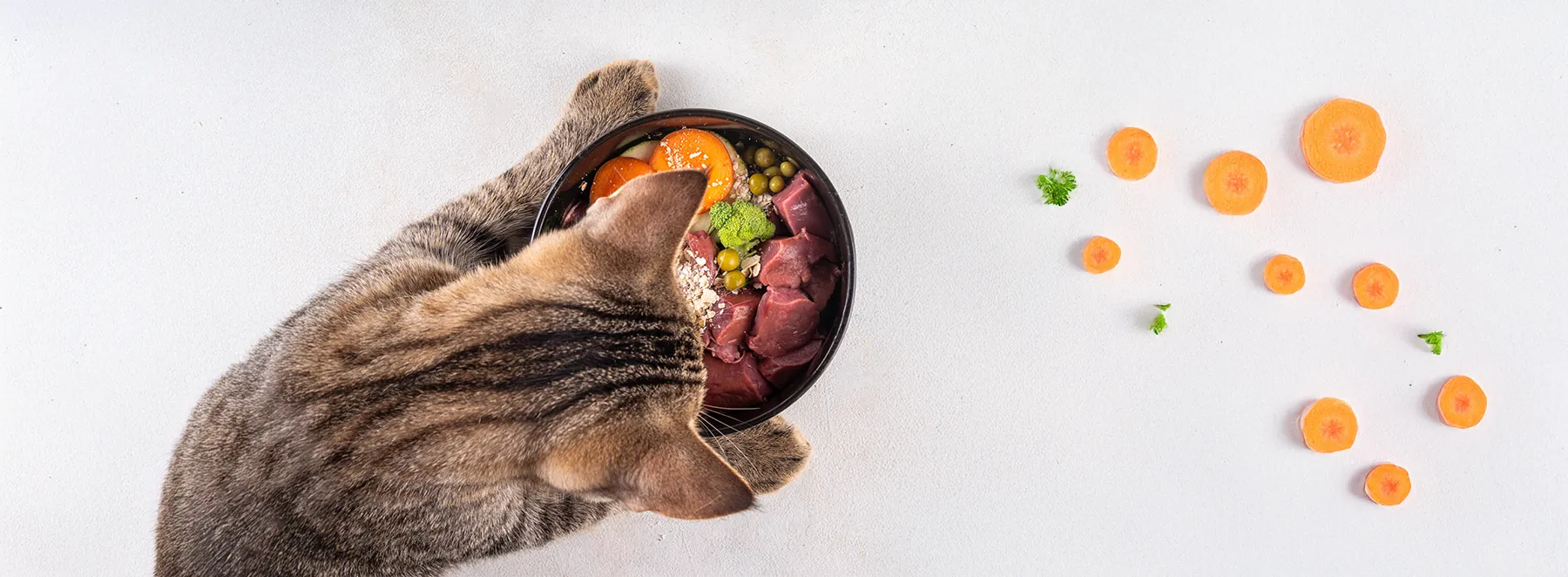
BARF for Cats: A Beginner’s Guide
How to successfully switch to natural feeding step by step
Table of Contents
Getting Started with BARF for Cats Made Easy
The decision to switch your cat to BARF is a wonderful step toward a more species-appropriate diet. Many cat owners want more control over what ends up in their cat’s bowl – fewer additives, fewer fillers, and instead fresh, high-quality ingredients that match the cat’s natural prey. At the same time, there are often some uncertainties: Will my cat accept the new food? How quickly can I switch? And how do I create balanced BARF meals?
How to Successfully Transition to BARF
The good news: with a bit of patience and the right approach, the transition works very well for most cats – regardless of whether they have been eating dry or wet food before. The most important thing is to accompany your cat with patience and allow her to get used to the new food step by step.
The Preparation Phase
Before starting the actual transition, it’s worth taking a short preparation phase. During this time, your cat can have positive first experiences with her new food without any pressure, making the switch much easier later on.
In this phase, you can already offer your cat small pieces of meat, ideally poultry, just to get familiar with it. The goal is not yet for her to eat the meat as a full meal, but to get used to its smell, texture, and taste.
During this phase, pay attention to three main points:
Eating habits: Does your cat prefer her food minced or in chunks, and does she like it at room temperature or slightly cooler?
Curiosity: Does your cat sniff raw meat with interest, or does she avoid it?
Preferences: Do you know your cat’s favorite treats? If not, find out – you can use them later as a “jackpot” ingredient during the transition.
After the preparation phase, the actual transition can begin. Here, it’s important to distinguish whether the cat is being switched from a) wet food to BARF or b) dry food to BARF. The process differs slightly depending on the previous type of feeding.
a) From Wet Food to BARF -
Step-by-Step Transition Guide
Cats that are already eating wet food have a big advantage: they’re used to moist meals, so the texture and mouthfeel of raw meat are familiar. The main challenge in switching is not the texture, but the new smell and taste. For this reason, the transition is usually much smoother than switching from dry food to BARF. Still, it’s best to proceed gradually.
Phase 1: First Taste Introduction
At the beginning, it’s simply about helping your cat recognize raw meat as food. Start by mixing tiny amounts – often just half a teaspoon – into her usual wet food. The portion should be so small at first that your cat barely notices it.
Phase 2: Gradual Increase of Raw Meat Content
Once your cat accepts the mix without any issues, you can slowly increase the proportion of raw meat in her meals. This should be done over several days or even weeks, depending on how sensitive and picky your cat is. Many cats begin to look forward to their new food during this stage, as the natural smell and flavor instinctively feel valuable to them. The meal will now consist of more and more fresh meat, while the amount of wet food decreases, until eventually the meals consist entirely of raw meat.
Phase 3: Transition to a Complete BARF Meal
Once your cat happily eats pure meat meals, you can move to the next step – creating a balanced BARF meal. Gradually add other essential components such as organs, bones (or bone substitutes), vegetables, and supplements to your cat’s diet. This way, a simple meat meal becomes a fully balanced ration step by step. This final phase can take a bit longer, as each new component requires an adjustment period. Be just as patient here as in the first phase, especially if your cat starts to enjoy her meals a bit less enthusiastically.
b) From Dry Food to BARF -
The two-stage path to feeding success
If your cat has only ever been fed dry food, she usually needs a little more time to switch to BARF, because the new food is very different from the old one. Your cat will be getting food that doesn’t resemble her previous diet in taste, texture, or smell: hard, crunchy kibbles feel completely different in the mouth than fresh raw meat. Therefore, the transition works best in three phases. Switching from dry food to BARF takes a bit longer this way, but it is also much more promising than an abrupt change.
Phase 1: From dry food to soaked food
In this first phase, the only goal is to get your cat used to the new texture of the food and thus a different mouthfeel. Start by adding a little water to the dry food. Then gradually increase the amount of water from meal to meal until the kibbles are soaked. This allows your cat to get used to a softer, moister consistency and to let go of the “crunchy feeling” she’s had with dry food up to now.
Phase 2: From soaked dry food to wet food
Once the soft texture of the soaked dry food is well accepted, switch to wet food to introduce a new taste and smell. To do this, first mix very small amounts of wet food into the soaked dry food. Over time, reduce the proportion of dry food and increase the wet food until there is only wet food in the bowl. Only when this step works reliably and your cat eats the wet food for several days should you begin introducing raw meat.
Phase 3: From wet food to BARF
Only now should the actual switch to BARF begin. Follow the steps described under “From Wet Food to BARF – Step-by-Step Transition Guide.”
When things stall – consciously adjust the pace
It’s completely normal for the transition not to be linear. Some cats make small progress and then seem to slip back into old habits. That’s not a setback, but a sign that you should slow the pace a bit.
Typical signals for “please slow down a notch” include:
the cat sniffs her food, then pulls back again
she eats only the old portion and leaves the new ingredients
the cat suddenly seems more suspicious than before
In these moments, it helps to go back one or two steps and resume where feeding was already working well. The most important thing during the transition, however, is always: patience! You are guiding your cat on your shared path toward a species-appropriate raw diet, but she sets the pace.
Please always remember: Switching to BARF is not a race, but a journey you take together. What matters is not how quickly your cat accepts her new food, but that you calmly give her the chance to get to know it and form positive associations. Whether the process takes a few days, several weeks, or even months: every small step closer is progress. With patience, understanding, and an adjusted pace, the transition succeeds for the vast majority of cats, and sooner or later they will enjoy their new meals with great enthusiasm.
These tricks increase acceptance of raw meat
Cats are curious, but they are also true creatures of habit. Not every feline will dive straight into raw meat; many first need to learn to perceive it as safe and interesting. With the following tips and tricks, you can gently and playfully introduce your cat to raw meat without any pressure:
Use favorite ingredients as flavor carriers: Particularly finicky cats can often be persuaded with familiar treats. A spoonful of yogurt or quark, an egg yolk or some cheese, or even a dollop of cream on the meat can work wonders. Sometimes it also helps to grind up the familiar dry food and sprinkle it over the new food. Once the new food has been positively associated as tasty, simply reduce the amount of this jackpot treat until you can leave it out entirely.
Playfully trigger the hunting instinct: In nature, eating for cats usually follows a hunting experience. You can make use of this instinct by tying a small piece of raw meat to a string and turning it into “prey.” This usually at least sparks the cat’s interest—and quite often the first courageous bites into the meat follow.
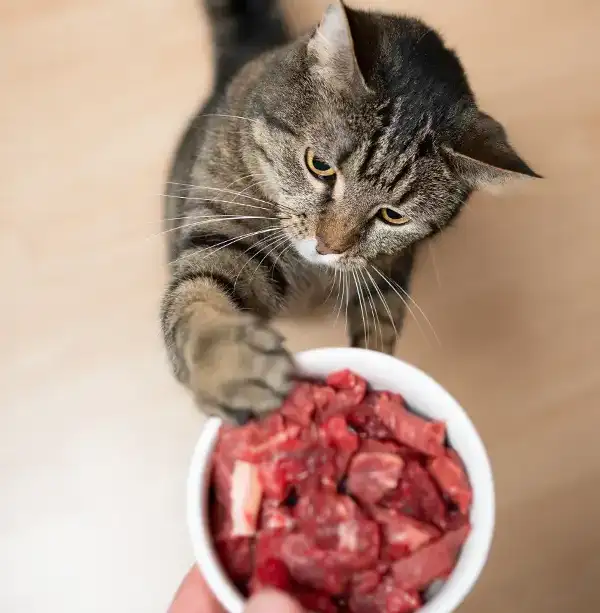
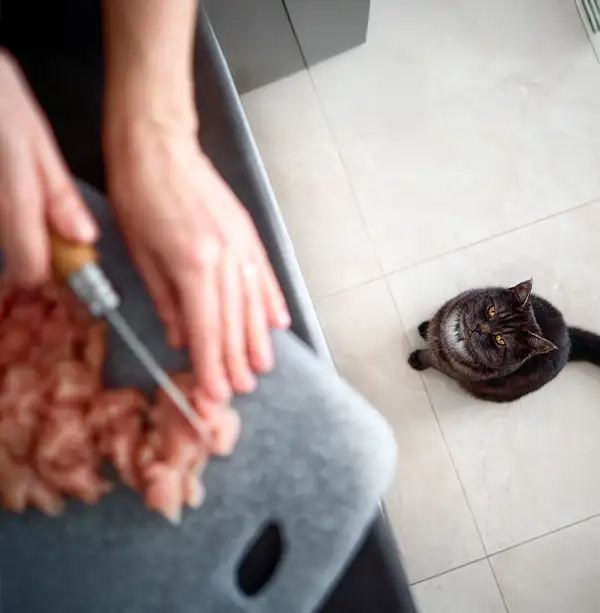
Slightly warm or blanch the meat: Raw meat develops more aroma and flavor when gently warmed. This usually increases acceptance because cats judge their food strongly by smell. At the same time, warmed meat is closer to wet food in taste and texture. Ideally, serve the meat at body temperature—about as warm as freshly caught prey. Meat straight from the fridge is often rejected because the cold can be off-putting and the aroma is less noticeable.
Find the right texture: Cats have very individual preferences when it comes to the texture of their food. Some prefer finely minced meat, others want something to chew. It’s worth trying different options until you discover which meat structure your cat likes best.
What happens in your cat’s body during the transition
During a diet change, it’s not just the food in the bowl that changes—many processes in your cat’s body do as well. Many cats have been conditioned for years to eat highly processed, carbohydrate-rich food. When switching to BARF, the digestive tract must begin to adapt again to unprocessed, fattier food and return to working as nature intended. This means, for example, that stomach acid becomes stronger, the intestinal environment changes, and the pancreas adjusts enzyme production to the higher amount of animal proteins and fats.
These adjustments are normal and beneficial, but they take time. During the transition period, there may occasionally be mild diarrhea, softer stools, or vomiting. This is usually harmless and disappears on its own after a short time. If you’d like to support your cat a little during this process, probiotic supplements are ideal for stabilizing the gut flora.
In short:
the digestive system must (re)learn to optimally process unprocessed animal proteins
with BARF, energy comes from fats rather than carbohydrates as in commercial food
stomach acid, gut flora, enzyme production, etc. must adapt to the new diet
temporary digestive issues like diarrhea and vomiting can occur and are usually harmless
probiotics containing beneficial bacteria can be fed to support the transition
When you should pause or stop the transition
Even though BARF works very well for most cats in the long term, there are rare exceptions where adjusting the transition—or even stopping it—makes sense. This is especially true if your cat doesn’t eat at all for an extended period or shows significant stress. Complete food refusal for 24–48 hours is always a warning sign—especially in overweight cats, where there is a risk of liver damage. In such cases, you should definitely go back to a familiar food to ensure adequate intake.
It can also happen that some cats, due to strong conditioning to their previous food—often after years of eating dry food—cannot be fully switched to BARF. That’s not a failure; it’s simply in the nature of some animals. In such cases, a high-quality wet food is a good alternative that is still much closer to a natural diet than dry food.
In the vast majority of cases, however, the transition succeeds—sometimes slowly, sometimes surprisingly quickly. Many cats that are initially skeptical develop real enthusiasm for their fresh new food after a few weeks. It’s worth sticking with it!
BARF with a plan – creating balanced recipes for cats
Admittedly, putting together a balanced BARF diet for cats isn’t always straightforward. There are several important factors to consider to ensure your cat gets all the necessary nutrients in the right ratios from raw meat meals. At the same time, we’ve learned that cats are often very picky and may not immediately eat all the key components needed for a complete diet. It is therefore essential to view every cat as an individual and create BARF recipes tailored to her.
Below, we’ll roughly explain how to assemble BARF recipes for healthy, adult, normally active cats. For growing cats or those in special life stages (e.g., illness, pregnancy, etc.), creating BARF recipes can be more involved. Especially in these cases—but also in general when in doubt—you should always seek help from nutrition experts.
Step by step to an individual BARF recipe for your cat
1) Calculate your cat’s BARF food amount
First, determine the appropriate total daily food amount for your cat and thus her nutrient needs. You can use the following rule of thumb: A cat needs 25–30 g of meat per kilogram of body weight per day. Supplements and vegetables are added on top.
Kittens or very active cats often need more, while older or overweight animals may need a bit less. In any case, especially after switching to BARF, you should closely observe your cat and adjust the amount of food if she gains or loses weight unintentionally.
The total food amount should be divided into multiple meals per day. For adult cats, two to four portions per day are usually recommended.
2) Divide the food amount into components
Once you’ve calculated the total food amount, the next step is to divide it among the individual components. Here, you take your cue from the composition of a natural prey animal—in the case of cats, ideally a mouse. Accordingly, rations should consist of 95% animal components complemented by 5% fiber. The exact composition of BARF rations can vary considerably from cat to cat and recipe to recipe. The following breakdown is therefore only a rough guide.
The animal portion of a feline BARF meal should consist largely of muscle meat with a good fat content of 10–15% of the total ration. In addition, organs such as liver, kidney, and spleen, as well as poultry gizzards and taurine-rich heart, are important components. If your cat accepts (ground) bones, these should make up about 10% of the bowl. Alternatively, supplements such as bone meal, eggshell powder, or dicalcium phosphate can be used to provide calcium and phosphorus in the correct ratio and amount. Finally, add 5% raw vegetables as an important source of fiber. Carrots and pumpkin are particularly suitable.
3) Choose BARF supplements strategically
When preparing BARF meals for cats, it’s necessary to supplement nutrients that the cat cannot obtain—or cannot obtain sufficiently—from meat alone, either with natural or synthetic additives. Essential nutrients that usually need to be added include taurine, calcium, iron, vitamin A, B vitamins, vitamin D, vitamin E, iodine, and sodium. Accordingly, supplements such as blood, cod liver oil, seaweed meal, salt, and taurine powder are among the essential additions.
More information on essential supplements for cats
Mini side note: Why is balanced composition so important with BARF meals?
A balanced composition of BARF meals is crucial to prevent both deficiencies and excesses. Cats—much like humans—need a variety of nutrients in specific ratios to keep all bodily functions running optimally. A one-sided diet, for example only muscle meat, can lead to long-term deficits in important vitamins and trace elements and cause health problems.
4) Prepare balanced BARF meals
Now for some practice after all the theory—here’s the precise guide to preparing balanced BARF meals for your cat according to a recipe:
1. Prepare all ingredients & utensils: First, gather the required amounts of all components. You can usually get everything you need at a BARF shop or supermarket. It’s best to thaw frozen meat in advance; it’s easier to handle and portion. Lay out all components and necessary tools within easy reach.
2. Make a supplement mix: Start by preparing a supplement mixture in a separate mixing bowl. If you’re using blood meal, first mix it with enough water (about 3 parts water to 1 part blood powder). Then add all powdered supplements such as seaweed meal, brewer’s yeast, bone meal, etc., and stir thoroughly. If you have supplements in tablet form, crush them and mix them in as well. You can set the finished supplement mix aside for now. Do not add oils or oily supplements to this mix; it’s best to add them directly to the meat at the end.
3. Prepare animal components to the desired size: Organs, fat, and bones should be ground very finely, especially at the beginning of BARF feeding, to increase acceptance. In some cases this may be necessary long-term if your cat won’t accept these components otherwise. Either buy organs, fat, and bones in chunks and run them (thawed) through the 3 mm plate of your meat grinder, or use pre-ground options from the BARF shop. The muscle meat, which makes up the bulk of meals, can remain chunkier for many cats. You can use the 8 or 13 mm grinder plate or buy meat in pieces. Collect all animal components in a large mixing container for the next steps.
4. Finely grate or roughly chop vegetables: Vegetables like carrots and pumpkin provide fiber for your cat. It’s therefore neither necessary nor useful to puree or cook them. It’s easiest to cut them into pieces and then roughly chop them in a blender, or alternatively finely grate them. For healthy, not-too-picky cats, that’s perfectly sufficient. Then add the vegetables to the meat mixture.
5. Combine the components: After placing all the animal components and vegetables into the large mixing container, add your previously prepared supplement mix and the desired oils. Then stir everything thoroughly—ideally by hand.
6. Portion the food: Finally, portion the prepared food into suitable containers, for example daily portions. Freezer-safe tubs, deli cups, or freezer bags work particularly well. The easiest way to portion is with a spoon or small ladle; depending on the consistency, using your hand also works. To measure portions precisely, place the container on a kitchen scale, tare it, and then fill in the required amount. Once everything is sealed, put the portions in the freezer—and you’ve conveniently prepped your cat’s BARF meals in advance. You only need to thaw and serve fresh each day.
5) Serve BARF meals the right way
Unlike dogs, cats are not scavengers and prefer their food fresh. It’s best to thaw the portion you need for the day in the refrigerator. Leftovers from the previous day are usually refused and can be discarded without guilt, as cats generally won’t accept meat that seems old. It’s also important that meals are not served straight from the fridge but at room temperature. If needed, you can add a splash of warm water (maximum 50 °C) to warm it slightly. For sensitive or still-skeptical cats, it can help to start by adding a familiar scent or taste. A little of the previous food or a dab of yogurt, quark, or egg yolk works well. Once acceptance is reliable, you can gradually phase out these toppings.
Which utensils do I need to BARF-feed my cat?
Many cat owners are initially unsure because they believe preparing BARF meals involves huge effort and requires buying lots of tools. In practice, however, it quickly becomes clear: with a few well-chosen utensils, preparation becomes much easier—and many of them are often already in your household.

Basic equipment for preparing BARF meals includes:
sharp knives & cutting boards – ideally used exclusively for raw meat
bowls in various sizes – for mixing, portioning, and temporarily storing the individual ingredients
precision scale and kitchen scale – important for accurate dosing of supplements as well as finished meals
freezer containers or bags – for freezing in portions

immersion blender, blender, or grater – an immersion blender or blender is ideal if your cat prefers a very fine vegetable texture; if she likes it a bit chunkier, you can simply coarsely grate the vegetables
mortar and pestle – for grinding eggshells or supplements in tablet form
disposable gloves – for hygienic handling of raw meat

A meat grinder is not mandatory, but it can be helpful especially if
you want to prepare larger quantities in advance
your cat prefers a very fine texture for her food
you regularly buy meat in pieces that need to be minced
Especially at the beginning, many BARF beginners simply use a knife and cutting board or rely on pre-ground meat. That’s perfectly sufficient and often the most practical for smaller amounts. An electric meat grinder only becomes interesting if you regularly prepare larger batches or prefer to mince the meat yourself while spending less time and effort. If you prepare small amounts or use pre-ground meat, you can easily do without a meat grinder permanently.
Hygiene – an important point when feeding BARF
When handling raw animal products, hygiene plays a central role. Always ensure processing is as clean as possible. Cats are naturally very resilient to germs like salmonella—humans are not. Therefore: clean surfaces with hot water after preparation, wash utensils thoroughly or put them in the dishwasher, and always thaw raw ingredients in the refrigerator without contact with other foods.
If you like, use a separate cutting board and dedicated knives and bowls for preparing BARF meals—this isn’t strictly necessary but it allows for a clear separation between utensils for cat food and your own meal prep. This also prevents accidental mix-ups.
Conclusion: 6 tips for a successful start with BARF
Tip 1: Make the switch step by step and with plenty of patience.
Tip 2: Always adjust the number and size of BARF meals to your cat and her preferences.
Tip 3: Base the percentage composition of BARF meals on natural prey such as mice and small birds.
Tip 4: It’s best to feed your cat according to a previously created recipe.
Tip 5: Tailor recipes specifically to your cat’s needs and adjust them over time as needed.
Tip 6: Use specialist literature to create BARF recipes or seek professional help from BARF consultants if you’re unsure.
For healthy, adult cats, with a bit of know-how and practice you can put together complete BARF recipes yourself. For kittens, cats with special needs, or illnesses, nutrient supply generally needs to be adjusted and planned even more carefully. In these cases, it’s often wise to seek support from trained BARF consultants.
Free requirement calculators & individual advice

Fat Calculator
To calculate the required amount of added fat when lean muscle meat contains less than 15% fat.

Seaweed Calculator
With this calculator you can easily determine the ideal amount of seaweed meal for your dog.

Calcium Calculator
As an alternative to bones, a calcium supplement can be fed. Use our calculator to determine the dosage.

Individual BARF Plans
Get advice from us and receive an individual BARF plan including recipes for your cat.
Frequently asked questions about starting BARF (FAQ)
How do I properly prepare BARF for cats?
You’ll find all the key information on how to properly prepare BARF meals for cats in the section “Step by step to an individual BARF recipe for your cat”.
How do you start BARF-feeding cats?
Tips and tricks for transitioning to BARF and for the first steps can be found in the section “How to successfully transition to BARF”.
How do you get a cat used to BARF?
A step-by-step guide to getting your cat used to BARF can be found either under a) From wet food to BARF or under b) From dry food to BARF.
How do I calculate the right BARF food amount for my cat?
The answer, along with more valuable tips for creating individual BARF recipes for your cat, can be found here: “Step by step to an individual BARF recipe for your cat”.
How long does the transition to BARF take for cats?
You can find an estimate of how long a BARF transition might take for cats in the section “When things stall – consciously adjust the pace”.
Can every cat be fed BARF?
Find out whether every cat can be BARF-fed and when you should refrain in the section “When you should pause or stop the transition”.
Is BARF dangerous because of germs or parasites?
The answer to whether BARF might contain germs that could be dangerous for humans can be found in the section “Hygiene – an important point when feeding BARF”.
Do I need supplements when feeding BARF?
The answer to whether supplements are necessary when BARF-feeding cats can be found in the section “Step by step to an individual BARF recipe for your cat”.