






Puppy BARF
How to successfully feed BARF in a healthy way in the new home
Table of contents
Puppy BARF: The most important questions to get started
“BARF is far too complicated for puppies.” Many dog owners hear this when they consider feeding their young dog fresh, self-prepared meals. In fact, there are numerous recommendations, warnings and myths surrounding puppy feeding – and beginners in particular are often unsettled by this.
However, nutrition during this stage of life plays a particularly important role. Puppies grow rapidly in a short time, their bodies develop quickly, and bones and muscles are built step by step. A suitable and balanced diet supports this development and lays the foundation for a healthy life as a dog.
The good news: Puppies can generally be fed a BARF diet without any problems. Even a transition to BARF when moving into a new home is usually very straightforward.
In this article, you will learn what really matters when feeding puppies with BARF – from the right food quantity and the structure of a feeding plan to the most common myths about puppy nutrition.
Is BARF suitable for puppies?
In principle, puppies can easily be fed a BARF diet. It is often recommended to raise young dogs on industrially produced food first and only switch to raw feeding later. However, this is not necessary and is often even counterproductive.
Especially during growth, a high-quality and as natural a diet as possible is particularly important. During this phase, the puppy’s body develops rapidly – bones, muscles and organs are forming and need optimal support. A balanced nutrient supply supports this process and lays the foundation for a healthy life as a dog.
After being weaned from their mother’s milk, puppies do not fundamentally need to be fed differently from adult dogs. In nature, young animals also receive the same food as adult animals of their species after weaning. The main difference lies in the amount and frequency of feeding: puppies eat more frequently and require significantly more food relative to their body weight.

Excursus: BARF and industrial puppy food – a brief comparison
To better understand, it is worth taking a brief look at the differences between BARF and industrially produced puppy food.
Industrial puppy food is usually highly processed and often contains comparatively high amounts of carbohydrates. Dry food for puppies can even consist of up to 50 % carbohydrates, usually in the form of grains.
However, young dogs can only digest starch to a limited extent. Only at around three to four months of age do they reach the digestive capacity of adult dogs – and even after that, the dog’s digestive system is not designed for large amounts of carbohydrates.
In contrast, the composition of BARF diets is closely based on natural prey animals. BARF meals therefore typically contain very few carbohydrates and are based on fresh, minimally processed ingredients.

Switching puppies to BARF – how to make the transition work
When a puppy moves into its new home at around eight to nine weeks of age, many owners quickly ask themselves: Should I stick with the current food – or can I switch directly to BARF?
Many puppies are initially fed commercial food by the breeder. In practice, however, it turns out that puppies usually react very easily to new food. A direct switch to BARF is often possible at this age, as their digestion can quickly adapt to new food. A gradual transition is often not necessary.
However, moving to a new home is a major change for the puppy. Separation from the mother and siblings as well as the new environment can cause stress. In the first few days, it may therefore happen that a puppy has a slightly reduced appetite. In most cases, eating behavior normalizes quickly.
A slower transition can be useful if the puppy already has digestive issues or reacts sensitively to food. In such cases, it can help to introduce the individual components of the meals gradually and monitor tolerance.
If you are unsure about the transition, a structured guide – such as a BARF starter guide for puppies – can provide additional orientation.
How much BARF does a puppy need?
Puppies require significantly more food relative to their body weight than adult dogs. This is completely normal, as their bodies need a lot of energy and nutrients during growth.
As a rough guideline, about 4–6 % of body weight per day is recommended. In certain growth phases, the requirement can even reach up to 8–10 %.
However, this requirement changes considerably over time. While puppies grow very quickly in the first months of life, growth slows down later. Small breeds are often almost fully grown by around six months, while large breeds have usually reached about two-thirds to three-quarters of their final size by that time.
As growth slows, energy requirements decrease as well. The daily food amount is therefore gradually reduced – first to around 3–5 % of body weight, and later to about 2–3 % once the dog is fully grown.
Important to know: These values are always only guidelines. The actual amount a puppy needs depends heavily on the individual dog. Factors such as age, activity level, metabolism and breed play a decisive role.
That is why the food amount should be adjusted regularly during growth. It is completely normal for the requirement to change over time and even fluctuate significantly in certain phases.
Guidelines at a glance: Food amounts for puppies and young dogs
Daily food amount for small breeds:
10 weeks: 6 - 8 % of body weight
16 weeks: 4 - 6 % of body weight
6 months: 3 - 4 % of body weight
Daily food amount for large breeds:
10 weeks: 6 - 10 % of body weight
16 weeks: 4 - 8 % of body weight
6 months: 4 - 6 % of body weight
18 months: 2 - 4 % of body weight
Why too much food can be problematic
The right food amount does not only mean feeding enough, but also avoiding overfeeding.
A dog’s growth is genetically determined. However, nutrition influences how quickly this growth occurs. If a puppy consistently receives too much energy through food, this can accelerate development.
Young dogs do not necessarily become overweight but instead grow faster in height and may appear lanky. Since bones and joints are not yet fully resilient at this stage, excessively rapid growth can place additional strain on the musculoskeletal system.
With a well-structured feeding plan, however, steady and healthy growth can be supported very effectively.
How can I recognize the right food amount?
Puppies should grow lean. Ribs and hip bones should be easy to feel but not visibly protruding.

To better assess development, it can be helpful to monitor weight regularly. Many veterinarians or breeders provide so-called growth charts that show approximately what weight a puppy should reach at a certain age. Weekly weighing helps to identify changes early and adjust the food amount if necessary – for example, if the puppy gains weight too quickly or not enough.
How often should a puppy be fed?
The digestive system of young dogs is not yet designed for large food quantities. Dividing the daily ration into several meals reduces strain on digestion, ensures a steady energy supply and allows nutrients to be absorbed evenly.
During puppyhood, three to four meals per day are usually recommended. As the puppy gets older, the number of meals can be gradually reduced. From around 16 weeks of age, puppies are often fed three meals, and at around six months, two meals per day are usually sufficient.
Puppies should not be fasted during the growth phase, as their energy requirements are particularly high during this time.
Why proper nutrition during growth is so important
Puppies grow very rapidly in a short period of time. This development is particularly noticeable in large dog breeds. While humans need many years to reach their final body weight, a Great Dane can weigh around 60 kg after just one and a half to two years.
This intensive growth phase places high demands on the body. A suitable and balanced diet supports the puppy in developing evenly and forms the basis for a healthy life as a dog. The goal of feeding should always be slow and steady growth.
High-quality ingredients such as fresh meat, vegetables and natural fats provide the growing body with many essential nutrients. When combined in a well-structured feeding plan, BARF can offer an excellent foundation for healthy development.
BARF feeding plan for puppies: How to structure the ration
The structure of a BARF feeding plan for puppies is less complicated than many initially think. In principle, it differs only slightly from that of an adult dog. The main difference lies in the higher food quantity and the greater number of meals, as energy requirements are significantly higher during growth.
Basically, a BARF ration consists of several components. These primarily include muscle meat, offal, green tripe and omasum, raw meaty bones as well as plant-based components such as vegetables and fruit. Depending on needs, the ration is supplemented with supplements such as oils, seaweed meal or cod liver oil.
However, there is one important peculiarity when feeding puppies with BARF: During this life stage, only soft, often ground bones are usually fed, as hard bones are often not well tolerated by young dogs.
Soft bones, however, have a lower mineral density and contain less calcium in particular. To still meet the requirement for these essential minerals, the proportion of raw meaty bones in puppy BARF plans is adjusted accordingly. While around 15 % of the animal portion is typically sufficient when feeding mixed bones, the proportion can increase to around 20 % when only soft bones are used. This adjustment ensures that your puppy receives sufficient minerals without feeding unnecessarily large amounts of bone.
Another point that often unsettles beginners is the question of the “perfect meal”. Many owners initially try to balance every single ration exactly. In practice, however, this is not necessary.
What matters is that all important components are fed in the correct overall amounts over several days or across a week. Variations in the composition of individual meals are completely normal and unproblematic. Even in nature, not every meal has exactly the same nutrient composition.
The plant-based portion of the ration should be designed to be as varied as possible. A vegetable or fruit mix, for example, can consist of at least three different types of vegetables and two types of fruit. This variety helps provide a wide range of nutrients and ensures a balanced feeding plan.
Do BARF puppies need supplements?
When feeding puppies with BARF, a complete prey animal is usually not fed. Components such as blood, brain or fur are often missing from the ration. However, these naturally provide various nutrients that should be considered in a prey-based diet.
In addition, many feed ingredients today come from industrial animal farming. The meat from these animals generally contains fewer nutrients than, for example, meat from wild prey animals or organically raised animals.
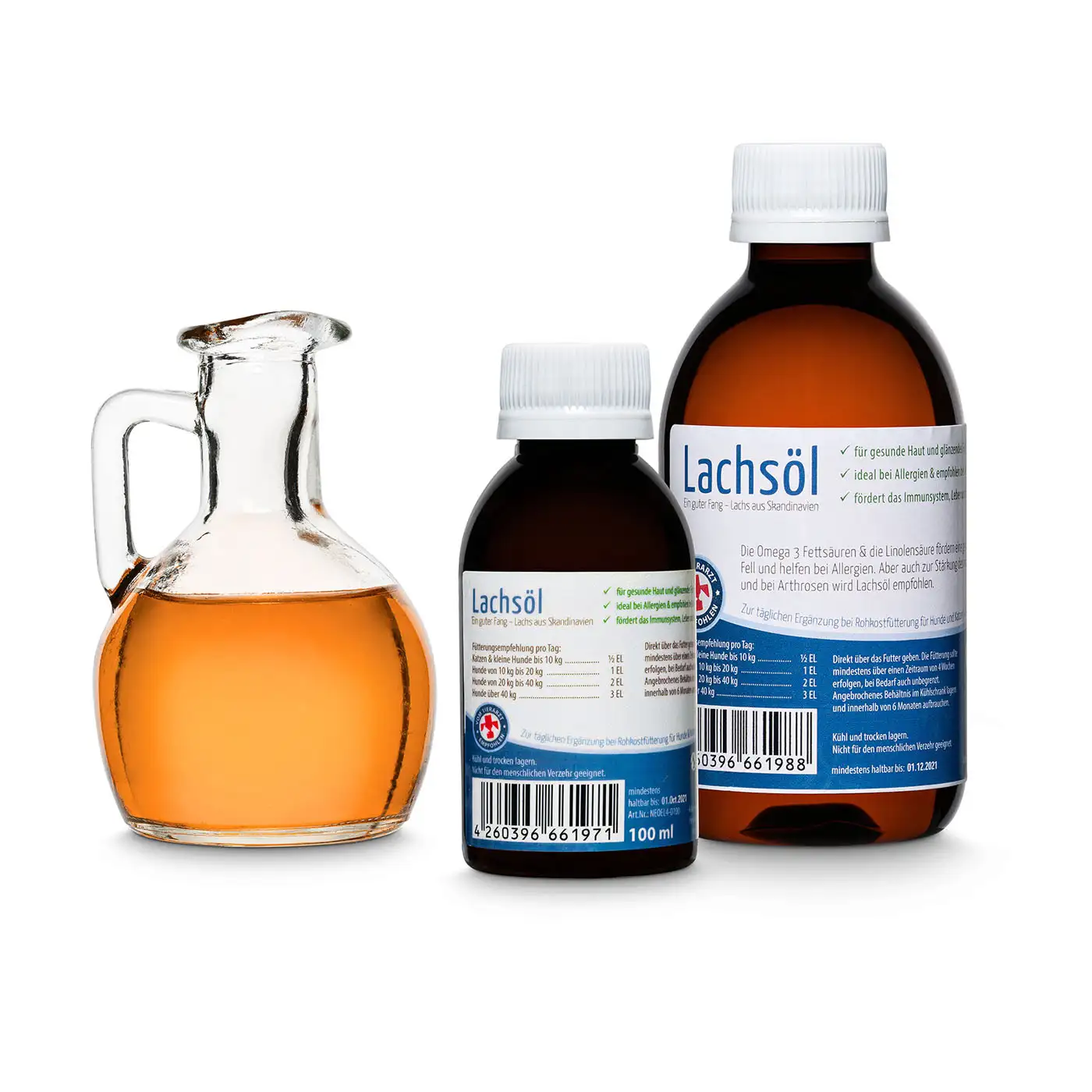
Against this background, supplements can make sense. Some are used to specifically balance certain nutrients and are therefore essential, while others can be used as needed. However, it is important to note: even natural supplements should not be used indiscriminately. What matters most is always the individual needs of the dog and a well-thought-out feeding plan.



Grains for puppies – useful or not?
Feeding grains is a topic that many dog owners feel uncertain about – especially when it comes to puppies. Since young dogs cannot fully digest starch in the first months of life, they are often fed low-grain or grain-free diets. Only as they grow older does digestion gradually adapt to more carbohydrate-rich food.
However, this does not mean that grains must be completely excluded. Small amounts can be used sensibly – for example, to gently accustom the body to different types of food. In this context, we speak of oral tolerance, meaning the body's ability to recognize food as tolerable.
For very active or rather lean puppies, the targeted use of grains or pseudo-grains such as amaranth can also be a way to provide additional energy.

Teething in puppies: What does it mean for feeding?
As puppies grow, not only their energy requirements change, but also their eating and chewing needs. A particularly formative phase is teething.
This usually begins at around 16 weeks of age and is typically completed by around seven months. While puppies initially have 28 milk teeth, an adult dog later has 42 teeth.
During teething, the need to chew increases significantly in many puppies. This also affects feeding: Suitable chews and appropriate bones can help loosen baby teeth, massage the gums and keep the puppy meaningfully occupied.
However, not all bones are suitable during this phase. Marrow bones and very hard, weight-bearing bones from large animals are unsuitable for puppies. They are very hard and can increase the risk of tooth fractures. In addition, marrow bones can become stuck over the lower jaw due to their shape.
With the right selection of suitable bones and chews, teething can be supported effectively – and at the same time, furniture and shoes are more likely to stay intact.


Common myths about BARF for puppies
With the increasing popularity of BARF, numerous myths about proper puppy feeding have also emerged. Below, some of these myths are examined more closely.
Myth 1: Puppies must receive every BARF component daily
Many owners believe that a puppy must receive all components of a BARF ration in every single meal – i.e. muscle meat, offal, bones and supplements daily and in perfectly balanced proportions.
In practice, however, this is not necessary. A puppy’s body can store nutrients and use them over a certain period of time. This means that variations in meal composition naturally balance out over several days.
It is therefore completely unproblematic if certain components – such as offal or bones – are not fed daily but distributed sensibly over the week.
What matters is the overall balance over several days – not the perfect individual meal.
Myth 2: Puppies need particularly large amounts of bones
It is often said that puppies need especially large amounts of bones and therefore a lot of calcium in order to grow healthily.
In reality, this is not the case. In a balanced BARF ration, the proportion of raw meaty bones is typically around 15 % of the animal portion. If only soft bones are fed, this can increase to about 20 %.
Beyond that, further increases are not beneficial. Excessive bone amounts can disrupt the natural nutrient balance and impair the absorption of other essential nutrients.
In practice, it quickly becomes apparent when too many bones are fed: very hard stools or so-called “bone stool” may occur, which can be uncomfortable for the puppy.
What matters is not “as much as possible”, but the right amount of bones.
Myth 3: Too much protein makes puppies grow faster
Many dog owners fear that a high protein content in food accelerates puppy growth and can lead to issues in the musculoskeletal system. Especially in connection with BARF, it is often assumed that the diet is “too high in protein”.
However, studies show that it is not the protein content that determines growth, but the total energy intake. A puppy’s growth is mainly influenced by how much energy it consumes overall.
If a puppy consistently receives too much energy – regardless of whether it comes from fat, carbohydrates or protein – growth can accelerate.
Reducing protein would usually only result in feeding more fat or carbohydrates, which may even increase total energy intake.
In a balanced BARF diet, protein mainly comes from high-quality muscle meat and corresponds to the dog’s natural diet. Under these conditions, an “excess” of protein is hardly possible and not a decisive factor in growth problems.
The key factor is not how much protein is in the bowl, but how much energy the puppy consumes overall.
Myth 4: The calcium-phosphorus ratio must be exact
Many dog owners are unsure whether they must calculate the calcium-phosphorus ratio precisely. It is often recommended to maintain an exact ratio of 1.2 : 1 – sometimes even adjusted artificially with additional calcium sources.
In practice, such precision is not necessary. In a balanced BARF ration, the ratio usually falls naturally within an appropriate range between about 1 : 1 and 1.2 : 1.
The assumption that phosphorus strongly affects calcium absorption and therefore requires strict balancing is based on older findings. More recent studies show that this relationship is less critical in practice than previously thought.
What is more important is avoiding extreme imbalances. In particular, excessive calcium intake can have negative effects by interfering with the absorption of other nutrients.
Artificial “fine-tuning” with additional calcium sources is therefore usually unnecessary and may disrupt rather than improve the natural balance.
A balanced feeding plan usually ensures an appropriate calcium-phosphorus ratio automatically.
Many uncertainties surrounding puppy feeding arise from such myths. However, a look at the fundamentals shows: with a well-structured feeding plan, BARF can be implemented safely and effectively for puppies.
Conclusion: BARF can be an excellent start to a dog’s life
Especially in the first months of life, you lay the foundation for your puppy’s development. During this phase, growth is rapid and requires a balanced supply of energy and nutrients.
BARF can be a very good way to feed your young dog in a species-appropriate manner and support a healthy start in life. Puppies can generally be fed BARF without problems, and switching in the new home is usually very straightforward.
What really matters is not a perfectly calculated plan in every detail, but a solid understanding: an appropriate food quantity, multiple meals per day and a balanced composition of the ration.
With this knowledge, a BARF feeding plan for puppies can be implemented safely and practically – creating a strong foundation for a long, active and healthy life. If you are unsure, certified nutritionists, BARF calculators or well-designed guides can help.
Frequently asked questions about BARF for puppies (FAQ)
1. Can you switch a puppy directly to BARF?
You can find the answer to whether puppies can be switched directly to BARF in the section "Switching puppies to BARF – how to make the transition work".
2. How much BARF does a puppy need per day?
You can find the correct food amount for a puppy or young dog in the section "How much BARF does a puppy need?".
3. How often should a puppy be fed BARF per day?
You can find out how many meals a puppy or young dog should receive per day in the section "How often should a puppy be fed?".
4. Should a puppy be fed grain-free on BARF?
You can read whether puppies should be fed grains or not in the section "Grains for puppies – useful or not?".
5. How do I create a BARF feeding plan for puppies?
You can learn how BARF meals for puppies should be structured in the section "BARF feeding plan for puppies: How to structure the ration".