






Advantages, disadvantages & risks of raw feeding for cats
What to consider when feeding cats a BARF diet
BARF for cats: benefits & risks
BARF for cats continues to be a controversial topic. While many cat owners appreciate the natural composition, high meat content and the ability to know exactly what goes into their cat's bowl, experts also point out the potential risks associated with raw feeding. It is therefore worth taking a closer look at both sides: there are both very understandable benefits and interesting scientific findings, as well as risks that should be known and taken seriously.
In this article, we take a look at the actual advantages and disadvantages of raw feeding for cats, what research has found so far and what matters when it comes to implementing BARF safely and meeting your cat's nutritional requirements.
Benefits of BARF – what studies & experience show
1. The visible benefits of BARF – what cat owners observe in everyday life
One of the biggest benefits of BARF is as obvious as it is simple: you always know exactly what goes into your cat's bowl. Instead of having to rely on a ready-made recipe, raw feeding allows you to select the individual components of your cat's food yourself. Meat, offal and essential supplements can therefore be specifically combined to suit your cat's individual needs.
This flexibility is particularly valuable for cats, as it allows different types of meat and individual components to be tailored to factors such as age, activity level, preferences or special requirements. If your cat is sensitive to a particular protein source, for example, you can simply avoid it consistently without having to work your way through the ingredient declaration of a new food every time.
At the same time, raw feeding focuses on fresh animal-based ingredients, which is ideally suited to the specific nutritional needs of cats: as obligate carnivores, their metabolism and, in particular, their digestion are especially adapted to animal-derived nutrients. A balanced BARF ration makes it possible to tailor the diet specifically to this physiology. We explain in more detail why a meat-based diet is particularly relevant for cats and what needs to be considered in general in our article "BARF for cats".

Plenty of moisture directly from food
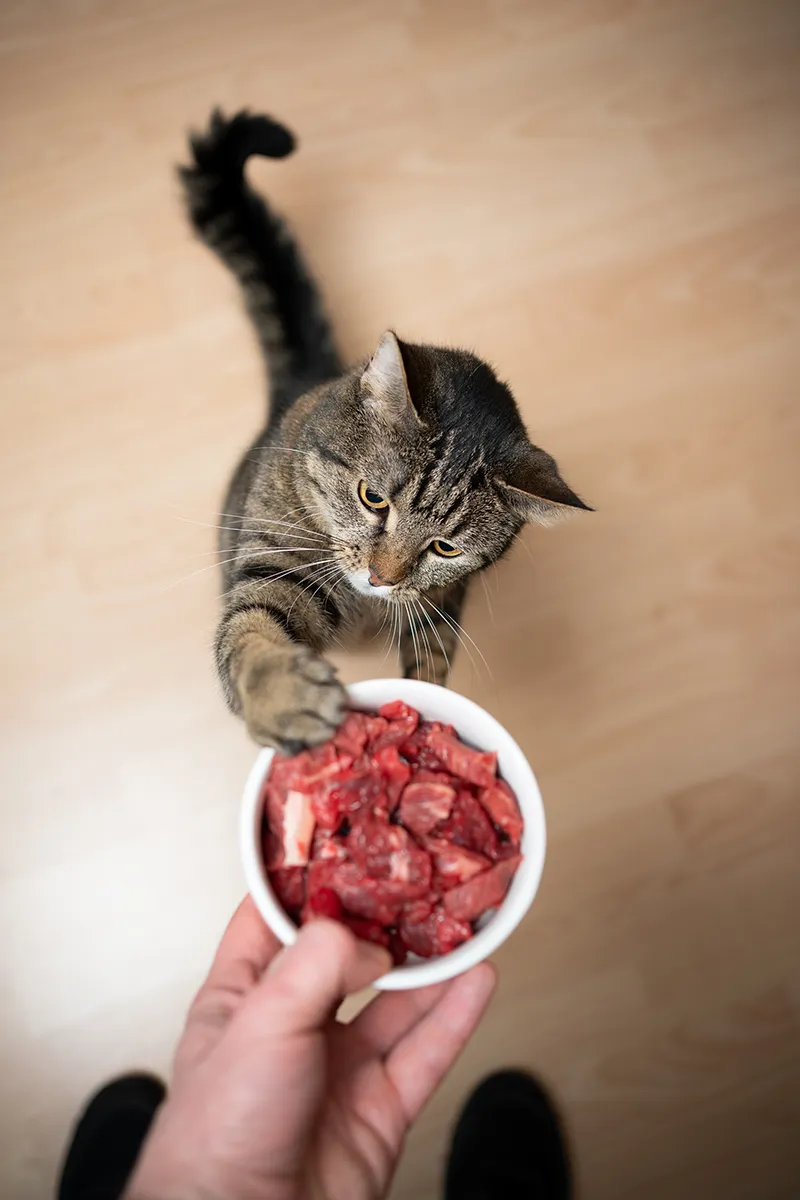
Another benefit that is particularly relevant for cats is that BARF naturally contains plenty of moisture. Cats are adapted to obtaining a large proportion of their fluid requirements from their food and have a comparatively weak thirst drive. A raw meat-based meal therefore complements this natural way of taking in fluids.
The fact that a raw-fed cat visits its water bowl less frequently does not necessarily mean that it is getting too little fluid. It already obtains a significant proportion through its meals and therefore often drinks less additional water.
Individualised food that many cats enjoy
Palatability can also be a benefit of BARF meals. Many cats really enjoy the smell, taste and natural texture of meat. And anyone who knows cats knows what a difference it can make in everyday life when food is not first inspected suspiciously from every angle, but eaten with a healthy appetite.
Of course, this does not apply to every cat and not always from the very beginning. Cats can become strongly accustomed to certain smells and textures and can sometimes be extremely sceptical about changes in their bowl. However, this does not fundamentally speak against BARF – often, the transition simply requires a little patience. We explain the best way to approach this in detail in our article "BARF for beginners: how to raw-feed cats correctly".
You may notice a difference in the litter tray too
A less glamorous but very practical benefit can ultimately be seen where cat owners tend to notice it quickly: in the litter tray. Many raw-fed cats produce comparatively small and compact stools. The odour is also often perceived as less intense.
This is consistent with the high digestibility of meat-based diets: the more the body can actually utilise from the food, the less ultimately needs to be excreted. Interestingly, this everyday effect is one of the benefits that is not only directly visible but has also been scientifically studied. We will take a closer look at this in the next section.
Visible benefits of BARF for cats at a glance:
fresh, minimally processed, clearly identifiable ingredients
full transparency regarding the composition of meals
individual adjustments to needs and preferences are possible
meat-based feeding suited to the nutritional physiology of cats
naturally high moisture content
well accepted by many cats
often smaller and more compact stools
targeted selection of individual meat and protein sources
2. What does science say? Studied benefits of raw feeding for cats
What actually happens when raw feeding is examined from a scientific perspective? There are now several studies specifically involving cats that show interesting differences between raw, cooked and more highly processed diets. Although research is still relatively limited – particularly when it comes to long-term studies – some of the findings can already be put into perspective quite well.
Raw food can be highly digestible
One particularly interesting aspect is the digestibility of BARF diets. Put simply, digestibility describes how much of what a cat consumes through its food can actually be utilised by its body.
In a study involving young cats, two raw diets were compared with a heat-processed canned food. Among other findings, the digestibility of protein and energy was significantly higher with both raw diets than with the canned food examined.
A further study involving adult cats reached a similar conclusion. In this study, a raw beef diet, a cooked beef diet and a high-protein extruded food were compared. Both the raw and cooked meat diets showed higher digestibility of protein, fat, energy and organic matter than the extruded food.


The studies therefore show that meat-based diets can be highly digestible. However, they do not prove that the raw state alone is responsible for this. The meat content, composition, quality of the ingredients used and processing can also play a decisive role in digestibility.
Less stool – where everyday experience meets research
This also provides a scientific basis for one of the visible benefits mentioned in the previous section. Food that can largely be utilised by the body leaves behind fewer indigestible components that ultimately need to be excreted.
In the previously mentioned study involving young cats, this was particularly clear: despite comparable food and energy intake, the cats fed the raw diets produced significantly less stool. Stool quality remained within the normal range. The smaller amount of stool that many raw feeders notice in their cat's litter tray is therefore not merely a subjective observation.
Changes also occur in the gut
Things become even more interesting when we look at something that cannot be seen from the outside: the gut microbiome. This refers to the community of countless microorganisms that inhabit the digestive tract and are involved in processes including digestion and metabolism.
Research to date shows that a raw meat-based diet can alter the composition of this microbiome. A scientific review examining the influence of raw feeding on the gut microbiome of dogs and cats concluded that the composition of gut bacteria and various metabolic products can differ depending on the diet. For example, certain groups of bacteria associated with the utilisation of protein and fat occur more frequently in raw-fed animals.
However, caution is needed when interpreting these findings, because a different microbiome is not automatically a better microbiome. So far, there have been comparatively few studies specifically examining raw feeding in cats, and many of them primarily describe which changes occur. The long-term effects of these differences on a cat's health have not yet been conclusively established.
What we can take away from the studies so far
Research does provide indications of potential benefits of BARF for cats – particularly in terms of digestibility and the resulting stool volume. At the same time, it would be premature to draw far-reaching conclusions such as “BARF makes cats healthier” or “BARF helps cats live longer”. Large, controlled long-term studies in particular are still lacking.
What studies have shown so far:
meat-based raw diets can be highly digestible
in individual studies, protein and energy from raw diets were utilised more efficiently than from wet or dry food
in one controlled study, higher digestibility was associated with significantly lower stool volume
raw feeding can alter the composition of the gut microbiome and various digestive metabolites
the long-term health effects of these changes have not yet been sufficiently researched

The disadvantages and risks of BARF for cats – what you need to know
As many benefits as BARF can offer, this form of feeding is not without its challenges and potential risks. However, this is no reason to categorise raw feeding as fundamentally dangerous or reject it altogether. The much more important questions are: Where do the risks arise, and what can you do yourself to keep them as low as possible?
With BARF, two areas in particular are important: the hygienic handling of raw meat and an adequate supply of nutrients that meets your cat's needs.
Raw meat can contain pathogens
The best-studied risk associated with BARF is the microbiological contamination of raw meat. Like other raw animal products – including meat intended for human consumption – BARF can contain bacteria such as Salmonella, E. coli or other potentially pathogenic microorganisms.
A study specifically examining commercial cat food published in 2025 analysed a total of 112 conventional and raw products. Cultivable bacteria were isolated exclusively from the raw foods examined. Other studies of commercial raw pet foods have also detected Salmonella and other potentially problematic bacteria. A scientific review of raw feeding in dogs and cats therefore concludes that microbiological contamination is one of the best-documented risks associated with raw food.
This may sound alarming at first – but it is important to put the findings into context: detecting a microorganism does not automatically mean that a healthy cat will become ill. As carnivores, cats are physiologically adapted to eating animal-based foods and can generally cope well with a certain level of microbial exposure. Factors such as the acidic environment of the stomach, the subsequent digestive process and the individual's immune status all play a role.
Confirmed transmissions were extremely rare in a large survey of households with raw-fed dogs and/or cats: the same pathogen was detected in both the affected person and the raw food in only 0.02% of all participating households.
In everyday life, hygienic handling of raw food is therefore particularly important. Even if the cat itself remains healthy, microorganisms can potentially be transferred via hands, bowls or kitchen surfaces, for example. Raw cat food should therefore essentially be handled with the same care as raw meat prepared for human consumption. Maintaining a reliable cold chain, defrosting food safely and thoroughly cleaning hands, bowls and work surfaces can already make a significant difference in everyday life.
Meat alone does not make a balanced diet for cats
The second important area of risk lies not in the raw meat itself, but in how the meals are put together. This is particularly relevant for cats. As obligate carnivores, they require certain nutrients in precisely balanced amounts. Their bodies cannot produce some of these nutrients at all, or cannot produce them in sufficient quantities, meaning they must be supplied through the diet.
Studies of homemade cat diets repeatedly show that recipes from books or the internet can contain nutritional gaps and unfavourable nutrient ratios. A review of commercial and homemade cat diets describes, among other issues, problems caused by inaccurate recipes and an inadequate supply of individual nutrients.
A professionally calculated BARF diet, however, can fully meet a cat's individual nutritional requirements. We therefore explain in detail which nutrients and supplements are particularly important when raw-feeding cats in our article "Supplements for raw feeding cats".
If you do not want to calculate and prepare your cat's BARF meals yourself, you can now opt for complete and balanced BARF meals. They already contain meat, offal and all necessary supplements in carefully balanced proportions, combining the benefits of raw feeding with particularly easy handling. This not only saves time when portioning and preparing meals, but – provided the food is formulated as a complete pet food – also reduces the risk of accidentally providing too little or too much of important nutrients.
Bones should be fed with care
Bones can contribute to calcium intake when raw feeding, but they are not essential. If they are fed, the type, size and amount must be suitable for the individual cat. Bones that are too hard or otherwise unsuitable can damage the teeth, for example, while larger pieces can be swallowed and, in unfavourable cases, cause problems in the digestive tract. A recent scientific review of raw feeding in companion animals lists dental fractures as well as injuries or obstructions of the oesophagus and gastrointestinal tract among the potential complications associated with feeding bones.
However, if you prefer not to feed bones, you do not have to give up BARF. Calcium can be incorporated into the diet in adequate amounts using appropriately dosed supplements such as bone meal or dicalcium phosphate.
BARF requires some organisation
Raw feeding requires a certain amount of preparation in everyday life – that's a fact. Freezer space, timely defrosting and good kitchen hygiene are all part of it. If you prepare your own BARF meals, you also need to portion the individual components correctly.
However, the amount of effort actually involved depends greatly on how you approach BARF. With pre-prepared portions or complete and balanced BARF meals, daily feeding can essentially be reduced to defrosting, weighing and serving. For many cat owners, BARF therefore becomes just as natural a part of their routine as any other feeding method after a short time.
The most important risks can be influenced
BARF is therefore not risk-free, but ultimately no feeding method is. However, the key risks associated with raw feeding are known and can largely be reduced through responsible handling and good planning.
Particularly important are:
high-quality ingredients suited to the individual cat
a balanced diet formulated to meet all nutritional requirements
particular care with kittens, cats with health conditions and vulnerable people in the household
consistent hygiene during storage, preparation and feeding
suitable bones or a safe alternative source of calcium
Why scientific assessments of BARF differ so widely
Anyone researching BARF for cats will quickly come across very different assessments. On the one hand, there are cat owners who report positive experiences, while on the other hand, veterinarians and professional associations often warn about potential risks. At first, this may seem contradictory. However, a closer look at the research helps explain why the two sides can arrive at different conclusions.
So far, we know more about the risks than the long-term benefits
Many studies on raw feeding focus on questions that are relatively easy to measure: Does the food contain Salmonella or other bacteria? Are potentially pathogenic or resistant microorganisms present? Does the diet examined provide all the necessary nutrients?
There are now a number of concrete findings in these areas. The potential long-term benefits of BARF, on the other hand, are much more difficult to investigate. To reliably determine whether raw-fed cats develop certain diseases less frequently over many years or perhaps even live longer, large groups of animals would need to be observed over long periods of time while taking numerous other influencing factors into account.

It is precisely these kinds of long-term studies that are still largely lacking. A critical scientific review of raw feeding points out that large cohort studies are lacking that would allow the long-term benefits and risks to be reliably weighed against one another. A recent review of the research published in 2025 also concludes that, although there are interesting indications of potential positive effects, further research is needed before robust conclusions can be drawn.
This explains part of the apparent imbalance: a well-documented risk is not automatically matched by an equally well-studied potential benefit.
Not all BARF diets are the same
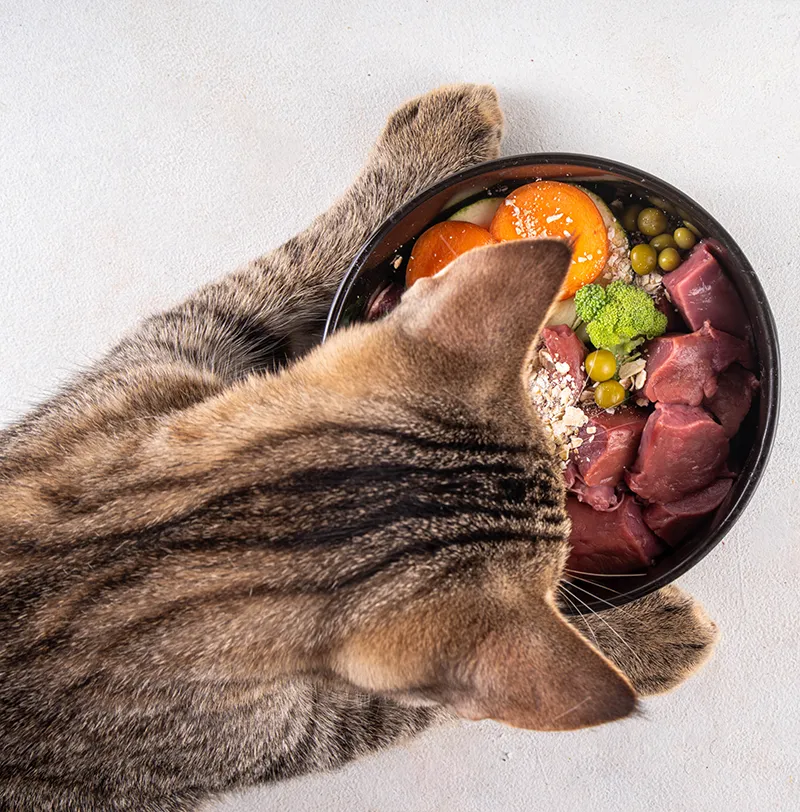
Raw food diets can also differ considerably from one another. Types of meat, fat and protein content, supplementation, processing, storage and hygienic quality can all vary significantly.
This is also relevant from a scientific perspective. A paper published in 2025 describes how there is still no completely standardised definition of exactly what constitutes a raw meat-based diet or BARF. This makes it more difficult to compare different studies directly.
Therefore, if a study identifies a problem with a particular raw food diet, the result cannot automatically be applied to every form of BARF. Conversely, the same applies to positive effects.
Why veterinarians often advise caution
Against this background, it is understandable why many veterinarians take a cautious view of raw feeding. In medicine, recommendations are generally based as far as possible on findings supported by robust evidence. With BARF, microbiological risks and potential nutritional imbalances in particular are comparatively well documented, while robust evidence for many long-term health benefits is still lacking.
However, this does not mean that research speaks exclusively against BARF. A review of raw feeding in dogs and cats describes changes in the gut microbiome and stool characteristics alongside the known risks. A recent overview of the current research also discusses potential positive effects on digestibility, metabolism and gut health, while likewise emphasising the still limited evidence base.


Less research does not automatically mean fewer benefits
The most important point when putting the evidence into perspective is therefore this: “Not sufficiently scientifically proven” does not mean the same as “scientifically disproven”.
Cat owners' experiences can provide valuable indications, but they cannot replace scientific evidence. Conversely, a lack of research should not be interpreted as proof that an observed effect does not exist.
The current evidence on BARF for cats is therefore primarily a snapshot. We now know quite a bit about digestibility, stool characteristics, changes in the gut microbiome and potential hygiene and nutritional risks. However, the effects of a correctly formulated raw diet on a cat's health over many years have not yet been sufficiently researched.
A fair assessment of BARF should therefore take both sides into account: the risks for which robust data already exist and the potential benefits for which there are some interesting initial indications, but which still require considerably more research.
Conclusion: A realistic assessment of BARF for cats
When practical experience and the current state of research are considered together, BARF for cats cannot simply be categorised as “good” or “bad”. Raw feeding offers several very tangible benefits: it allows for a transparent and individually adaptable diet based on fresh, animal-based ingredients, naturally provides plenty of moisture and can achieve very high digestibility. For cats as obligate carnivores in particular, a properly formulated, meat-based diet can therefore be an interesting way of meeting their specific nutritional needs.
At the same time, BARF is not something that simply takes care of itself. A bowl of raw meat alone does not make a balanced meal. Cats have specific nutritional requirements, and these need to be taken into account when formulating their diet. Raw meat can also contain microorganisms, which means that careful storage, defrosting and kitchen hygiene are essential.
The good news is that many of the known risks do not inevitably arise from raw feeding itself, but primarily when mistakes are made in diet formulation or hygiene. If you understand the basics, use high-quality ingredients and formulate meals to meet your cat's nutritional requirements, many of these risks can be specifically reduced. If you prefer not to calculate and mix the food yourself, complete and balanced BARF meals now offer a simple way to combine the benefits of raw feeding with a pre-balanced supply of nutrients.
For safe and balanced raw feeding, three things are therefore particularly important:
1. A complete and balanced diet that takes all of your cat's essential nutritional requirements into account.
2. The use of high-quality ingredients and hygienic handling of both the raw ingredients and the prepared food.
3. An individualised feeding approach suited to your cat's age, health status and individual needs.
BARF is neither a miracle solution nor inherently a risk. It is a form of feeding that requires knowledge and a certain degree of responsibility, but in return gives you a great deal of control over what goes into your cat's bowl every day. And for many cat owners, that is precisely one of its greatest benefits.
Frequently asked questions about the benefits & risks of BARF for cats
What are the benefits of BARF for cats?
You can find the visible and scientifically studied benefits of BARF for cats in the section "Benefits of BARF – what studies & experience show".
What are the disadvantages and risks of BARF for cats?
You can find the answer to the question of what disadvantages and risks BARF may have for cats here: "The disadvantages and risks of BARF for cats – what you need to know".
Can cats get Salmonella or other pathogens from BARF?
You can learn more about the risk of microbial contamination in BARF under "Raw meat can contain pathogens".
Can BARF cause nutrient deficiencies in cats?
You can find important information about potential nutrient deficiencies when raw feeding in the section "Meat alone does not make a balanced diet for cats".
Are complete BARF meals for cats nutritionally complete?
You can find out whether nutritionally complete BARF meals for cats are available in the section "Meat alone does not make a balanced diet for cats".
Why do raw-fed cats often drink less?
You can read why raw-fed cats often drink less in the section "Plenty of moisture directly from food".
What does science say about BARF for cats?
Scientific studies and findings on BARF for cats are summarised in the section "Studied benefits of raw feeding for cats".
Studies on raw feeding in cats
Anturaniemi, J., Barrouin-Melo, S. M., Zaldívar-López, S., Sinkko, H., & Hielm-Björkman, A. (2019). Owners' perception of acquiring infections through raw pet food: a comprehensive internet-based survey. Veterinary Record, 185(21), 658. Full text.
Butowski, C. F., Moon, C. D., Thomas, D. G., Young, W., & Bermingham, E. N. (2022). The effects of raw-meat diets on the gastrointestinal microbiota of the cat and dog: a review. New Zealand Veterinary Journal, 70(1), 1–9. Full text.
Cammack, N. R., Yamka, R. M., & Adams, V. J. (2021). Low Number of Owner-Reported Suspected Transmission of Foodborne Pathogens From Raw Meat-Based Diets Fed to Dogs and/or Cats. Frontiers in Veterinary Science, 8, 741575. Full text.
Davies, R. H., Lawes, J. R., & Wales, A. D. (2019). Raw diets for dogs and cats: a review, with particular reference to microbiological hazards. Journal of Small Animal Practice, 60(6), 329–339. Full text.
Ganz, H. H., Jospin, G., Rojas, C. A., Martin, A. L., Dahlhausen, K., Kingsbury, D. D., Osborne, C. X., Entrolezo, Z., Redner, S., Ramirez, B., Eisen, J. A., Leahy, M., Keaton, C., Wong, J., Gardy, J., & Jarett, J. K. (2022). The Kitty Microbiome Project: Defining the Healthy Fecal “Core Microbiome” in Pet Domestic Cats. Veterinary Sciences, 9(11), 635. Full text.
Hamper, B. A., Kirk, C. A., & Bartges, J. W. (2016). Apparent nutrient digestibility of two raw diets in domestic kittens. Journal of Feline Medicine and Surgery, 18(12), 991–996. Full text.
Kerr, K. R., Beloshapka, A. N., Morris, C. L., Parsons, C. M., Burke, S. L., Utterback, P. L., & Swanson, K. S. (2013). Evaluation of four raw meat diets using domestic cats, captive exotic felids, and cecectomized roosters. Journal of Animal Science, 91(1), 225–237. Study.
Kerr, K. R., Vester Boler, B. M., Morris, C. L., Liu, K. J., & Swanson, K. S. (2012). Apparent total tract energy and macronutrient digestibility and fecal fermentative end-product concentrations of domestic cats fed extruded, raw beef-based, and cooked beef-based diets. Journal of Animal Science, 90(2), 515–522. Study.
Kiprotich, S. S., Altom, E., Mason, R., & Aldrich, C. G. (2025). Reconciling the definitions of raw meat-based diets and biologically appropriate raw foods for companion animals: a mini review. Frontiers in Veterinary Science, 12, 1547953. Full text.
Lyu, Y., Wu, C., Li, L., & Pu, J. (2025). Current Evidence on Raw Meat Diets in Pets: A Natural Symbol, but a Nutritional Controversy. Animals, 15(3), 293. Full text.
Nüesch-Inderbinen, M., Treier, A., Zurfluh, K., & Stephan, R. (2019). Raw meat-based diets for companion animals: a potential source of transmission of pathogenic and antimicrobial-resistant Enterobacteriaceae. Royal Society Open Science, 6(10), 191170. Full text.
Reboul, G., Malkowski, A. C., Yu, Y. T., Gu, Y. M., Sams, K. L., Umbarger, J. M., Franklin-Guild, R. J., Jin, Y., Chen, Z., Stanhope, B. J., Wendel, B. R., et al. (2025). Analysis of the microbiota of raw commercial feline diets to prioritize food safety investigations. Communications Biology, 8, 1349. Full text.
Schlesinger, D. P., & Joffe, D. J. (2011). Raw food diets in companion animals: a critical review. The Canadian Veterinary Journal, 52(1), 50–54. Full text.
Villaverde, C., & Chandler, M. (2022). Commercial vs Homemade Cat Diets: What you need to know. Journal of Feline Medicine and Surgery, 24(5), 415–428. Full text.